

Cultivating Sovereignty: The method that uproots the madness
This model, unique to Sssynchronicities, LLC, goes much further than simply managing symptoms; It facilitates a total shift in how one inhabits their life. This model views complex trauma (C-PTSD) as an invasive root system in the garden of your psyche. To experience true personal freedom & contentment, effort and focus must be expanded beyond trimming the weeds—By working together from a space of mutual trust and positive regard, the process for extracting these trauma roots at their source is illuminated.
This work is Transpersonal, meaning it bridges the gap between evidence-based clinical psychology/psychotherapy & the existential journey of self actualization/inner peace/absolute potential. Individuals transform from a space of resentment, pessimism, and hopelessness that had previously served as a tether to a tragic past, to a sovereign space, guided forward with true self-love, trust, and success.

A Dedication of Clinical Origin: I dedicate this methodological synthesis to Amanda—Mentor, Peer, and Cosmic Connection—whose role in helping lay a strong clinical foundation and providing timely personal and professional support has shown to be a constant positive influence on my overall growth as a human and psychotherpaist.
Without your ability to see the clinician I hadn’t yet grown into, and your consistent unconditional positive regard, the evolution of this methodology and my scope of practice could have never been possible. May my gratitude for you last 1000 lifetimes, and then begin anew.
Thank you.
For existing and prospective Clients:
The Foundation: Stability and Safety
The Sssynchronicities model prioritizes personal well-being above all else. The use of Maslow’s Hierarchy of Needs, ensures that individual foundational needs are addressed first. If life becomes overwhelming, CBT (cognitive behavior therapy) and DBT (dialectical behavior therapy) concepts and skills (tools for emotional regulation and distress tolerance) are introduced to stabilize current foundations. In this model, self-care isn't a luxury—it is the essential baseline that allows the deeper work to begin and maintained.
The Four Stages of Evolution
1. Information: Building the Forensic Map
The process begins with a deep dive into one’s history, mapping out the various schemas (unhelpful lifelong patterns/ideas) and use psychosocial development models to understand how development and life stages affected and influence both the individual and their lifetime relationships (past & present caregivers, authority figures, partners, family, friends, etc.)- to gain a deep understanding of the “why” of past trauma and how it remains active in the here and now. Focus is also aimed at examining ancestorial lineage, somatic expression (chronic physical/medical symptoms caused by trauma) as it connects with energetic expression, using vagal nerve and chakra exploration.
2. Understanding: Real-Time Clarity
Clients learn to see how far and deep the roots of their trauma exist in their current gardens. The use of Modern Feminist Theory is employed to help distinguish between feelings reflecting one’s genuine inner-truth, and the outdated generational and societal pressures that have colonized one’s basic autonomy. This stage turns "why is this happening?" into "I see exactly how this works."
3 & 4. Acceptance & Mindset Change: The Shift to Source
This is when the ice of the eternal winter starts to thaw and the first traces of Spring begin to appear. By staying present and using learned tools during a moment of challenge, the brain receives 3D proof of safety, trust, and competence. This evidence triggers an instantaneous Mindset Change, finally allowing one the gift of no longer feel like a hostage to their history; Effectively becoming the sovereign host of their own life.
The Sovereign Standard: Accountability & Motivation
This protocol is a high-performance partnership. Because this process involves uprooting deep-seeded patterns and trauma (a literal and metaphorical stripping away of the old mindset) true success requires a specific type of commitment:
Intrinsic Motivation: One must have a fundamental hunger to reclaim one’s power. This work requires active participation in one’s own evolution.
Radical Accountability: This methodology will not work for those in the current role of passive observer. Clients are responsible for the daily application of learned tools and the maintenance of foundational needs.
The Clinical Verdict: Motivation and accountability are imperative. Without them, this method will not be helpful. The method provides the map and the tools, but the Client must be the one to walk the path.
Final Note: An Infinite Level Up
Healing isn't a finite destination; it’s an Infinite Leveling Up. Once one moves past their deepest traumas, the process stops being terrifying and starts being exciting. Every new level of consciousness is a new horizon to explore. The goal shifts to Harmony —a state of biological and existential resonance that allows one to finally return to their true, unconditioned, higher self.
For Professionals/Providers: This model provides a structured roadmap for transitioning from a victim/hostage state (trauma-conditioned) to a sovereign state (source-driven). It bridges evidence-based clinical practice with transpersonal psychotherapy, ensuring that the clients evolution of personal growth is anchored in biological and psychological safety.
I. The Infrastructure: Maslow’s Hierarchy of Needs
Maslow’s Hierarchy serves as the operational floor and primary prioritization tool of this model. It is monitored throughout all four stages to ensure the client possesses the physiological and psychological bandwidth required to process deep trauma.
The DBT/Maslow Bridge: To stabilize the foundation of the hierarchy, the protocol actively utilizes DBT skills, including Emotion Regulation, Distress Tolerance, Interpersonal Effectiveness, and Mindfulness, to meet bottom-tier physiological and safety needs.
The "Pause" Protocol: If a lower-level need becomes compromised, the four-part model is paused. The meeting and stabilization of foundational needs is prioritized before the transpersonal process resumes.
II. The BiPhasal Four-Stage Mindset Evolution Model
Phase One: Informational Mapping (The Intellectual Map)
Stage 1: Information Collection (Forensic Synthesis) This stage is an active, forensic inventory used to build the "War Room" of the psyche. It involves high-fidelity data collection regarding trauma history, current schemas, and energetic blockages.
Schema Synthesis (Jeffrey Young): Identification of the 18 early maladaptive schemas (e.g., Abandonment, Subjugation) rooted in early development.
Psychosocial Development (Erik Erikson): These stages function as a Developmental Curriculum to determine what was meant to be learned and what was historically or currently possible for the patient, caregivers, family, and ancestors at any given time.
Clinical Application: While Sssynchronicities, LLC primarily serves those 30+, work with younger populations (early-to-mid 20s) utilizes a mild version of the model.
Modern Feminist Theory: Integration of a feminist critique to identify systemic and patriarchal conditioning. This allows the patient to distinguish between personal pathology and internalized societal subjugation.
CBT/DBT Inventory: Collection of raw data regarding cognitive distortions (CBT) and the assembly of the tactical toolkit (DBT) needed to secure the Maslow base.
Ancestral Mapping: Identification of trauma "roots" within the lineage or collective unconscious (Jung).
Somatic/Energetic Assessment: Evaluation of Vagus Nerve function (Polyvagal Theory) and Chakra blockages where trauma has somatized.
Stage 2: Understanding (Intellectual Praxis) The phase of "putting the map into practice," where the patient recognizes the mechanical nature of their trauma in real-time.
Developmental Logic: Application of the Erikson audit to logically assess the historical and current capabilities of caregivers and family, facilitating a forensic shift from resentment to understanding.
Systemic Deconstruction: Using Modern Feminist Theory to analyze power dynamics in current and past relationships, reframing the "Hostage" state as a byproduct of externalized power.
Dialectical Application: Connecting Stage 1 data to current triggers and somatic responses.
The "Root and Garden" Metaphor: Identification of trauma as an invasive root system. Stage 2 identifies the root’s trajectory and depth prior to extraction.
Phase Two: Somatic Integration (The Lived Terrain)
Stages 3 & 4: Acceptance and Mindset Change (The Final Destination) A unified "Lightbulb Moment" triggered by somatic and energetic verification.
The Somatic Break: The patient utilizes DBT skills and Vagal Toning to remain present during the "uprooting" of the trauma root.
Lived Acceptance: The brain receives 3D proof that survival is possible without the old schema or external "Puppet-Master" nodes.
Mindset Change: The instantaneous result of the transpersonal shift. Once sovereignty is Accepted somatically, the mindset shifts automatically from "Hostage" to Sovereign Host
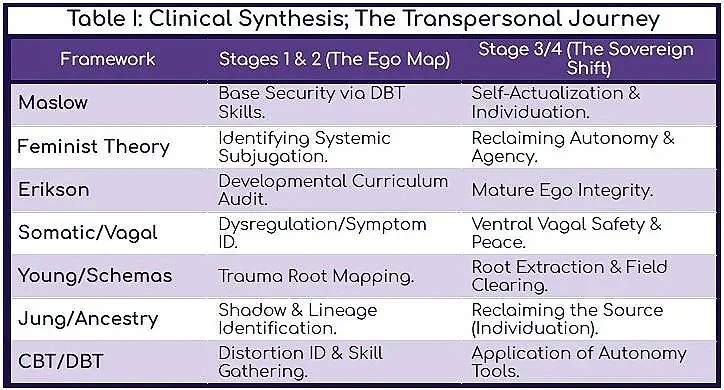
III. Transpersonal Foundations: Infinite Leveling
This model is transpersonal because it treats the individual as a sovereign source undergoing an infinite spiritual homecoming. It addresses the Vagas Nerve and Chakras biological and subtle conduits for this power.
The Shift from Hopeless to Excited: Once systemic trauma roots are managed, the process evolves into Infinite Leveling Up.
New Horizons: Consciousness expansion is no longer perceived as a threat to the ego, but as an exciting development of the Self. The goal is harmony, achieving biological and spiritual resonance.
IV. Nonlinear Mechanics of Progress
The protocol is non-linear, functioning as a spiral or multi-leveled resonance rather than a finite progression.
Fractal Processing: Integration occurs in layers. Achieving Stage 3/4 on a specific issue may reveal a deeper "root" requiring a return to Stage 1.
Iterative Evolution: Starting the process "over" is a requirement of deep work. As the "Source" strengthens, it becomes capable of uprooting ancient trauma systems that were previously inaccessible.
VI. The Imperative of Motivation and Accountability
This protocol is a high-participation methodology. Because it requires the active "uprooting" of deeply somatized trauma and the rigorous application of dialectical skills, it is not a passive treatment.
Intrinsic Motivation: The patient must be fundamentally driven to achieve sovereignty. Without a commitment to move from "Hostage" to "Host," the somatic and intellectual friction of the process will result in stagnation.
Personal Accountability: The patient is responsible for the daily application of DBT tools and the maintenance of their Maslow base.
Clinical Verdict: Motivation and accountability are absolutely imperative to success of the model. Without these factors, this methodology will not be effective, as the sovereign source is reclaimed only by the individual willing to perform the work of the return.
Selected peer-reviewed References & Clinical source materials
Erikson, E. H. (1950). Childhood and Society. New York: Norton. (The foundation for Psychosocial Developmental Audits).
Linehan, M. M. (1993). Cognitive-Behavioral Treatment of Borderline Personality Disorder. New York: Guilford Press. (The source for DBT Stabilization Skills).
Maslow, A. H. (1943). A theory of human motivation. Psychological Review, 50(4), 370–396. (The Operational Floor for clinical priority).
Porges, S. W. (2011). The Polyvagal Theory: Neurophysiological Foundations of Emotions, Attachment, Communication, and Self-regulation. New York: W. W. Norton & Co. (The framework for Vagal Toning and Somatic Security).
Young, J. E., Klosko, J. S., & Weishaar, M. E. (2003). Schema Therapy: A Practitioner's Guide. New York: Guilford Press. (The diagnostic tool for Trauma Root/Schema Extraction).
Jung, C. G. (1959). The Archetypes and the Collective Unconscious. (R. F. C. Hull, Trans.). Princeton, NJ: Princeton University Press. (The source for Shadow Work and Ancestral Mapping).
Wilber, K. (2000). Integral Psychology: Consciousness, Spirit, Psychology, Therapy. Boston: Shambhala Publications. (Supporting the Transpersonal and Infinite Level-Up framework).
Gilligan, C. (1982). In a Different Voice: Psychological Theory and Women's Development. Cambridge, MA: Harvard University Press. (Foundational to the Modern Feminist Theory integration).